
Why are Balinese people known for their warm hospitality?
One day, I was assigned to take an American couple on a day trip to Nusa Penida. I picked them up early in the morning from the property where they were staying in Ubud. As soon as I arrived in the lobby, I sent them a WhatsApp message to let them know I had arrived as their driver, assigned through the booking agent. I did this without rushing them, allowing them to get ready at their own pace. Everything had already been arranged in advance.
A little while later, they came out to meet me. I greeted them both warmly, giving each of them equal attention to ensure that neither felt overlooked. I then struck up a casual conversation to build rapport, put them at ease, and establish a friendly connection.
Once they were comfortably seated in the car, I explained our journey from Ubud to Sanur Harbour, describing the route and what they could expect along the way. However, the distance was relatively short, leaving me with little to say about the journey itself. Instead, I focused on learning about their stay in the property, asking about their experiences and impressions so far. I saw this as a better opportunity to engage with them, understand their perspectives, and make the journey feel more personal.
As soon as the American couple and I arrived on Nusa Penida, a local driver was already waiting for us at the harbour, holding up a white sheet of paper with the couple’s names written on it. He greeted us with a smile. I could easily recognize him because I had contacted him via WhatsApp before our arrival to confirm that he would be there and ask him to describe what he would be wearing. This made it easy for me to spot him among the crowd of drivers waiting for arriving visitors.
The most interesting part of our day trip to Nusa Penida was not the places we visited, but a question the American couple kept asking me: “Why are Balinese people so friendly?”
They were so curious that they even searched the internet for more information to confirm their impressions. They came across information suggesting that Bali had a relatively low crime rate, which seemed to reinforce their sense of safety and trust.
During lunch, they brought up the same question again, genuinely eager to understand why Balinese people were so welcoming and friendly. Their curiosity made me reflect on something that I had perhaps taken for granted: the warmth and hospitality that are such an important part of Balinese life.
My answer caught them by surprise. “It’s because you bring money,” I said with a smile. “If I’m not friendly to you, how can I expect business to come my way?” They burst out laughing at my honest and straightforward answer.
I then continued explaining that, beyond business and financial benefits, Balinese friendliness also has deeper roots in our culture, traditions, and values, as I’ll explain below.
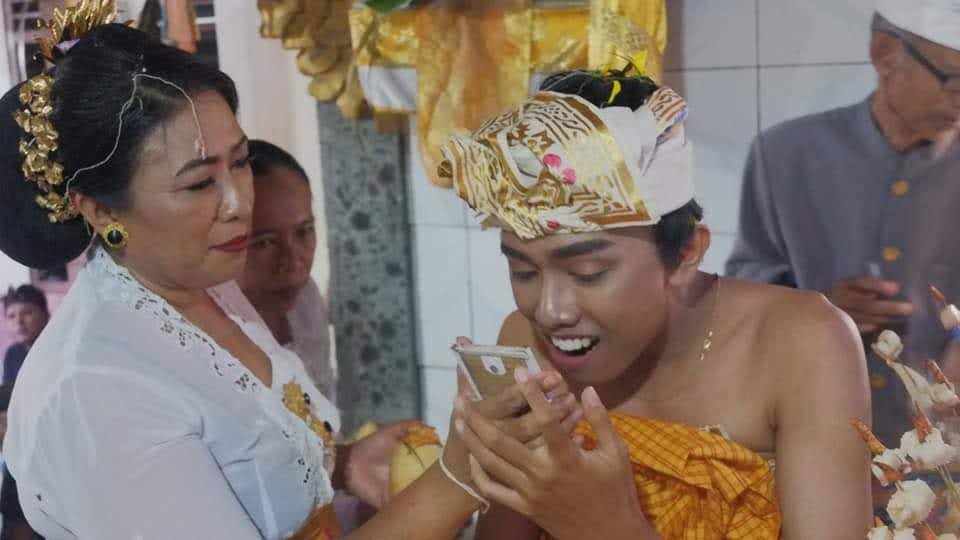
Metatah: a Balinese term for the traditional tooth-filing ceremony
The Journey from Coarse Instincts to a Refined Heart
A story of Balinese Hindu tradition, the passage into adulthood, and the lifelong work of becoming a better human being
One of the reasons visitors often describe Balinese people as friendly, welcoming, and warm-hearted is the island’s deep-rooted culture of hospitality, respect, and community. Yet behind the smiles that visitors encounter lies a world of values, rituals, and philosophical teachings that have shaped Balinese life for generations.
Among these traditions is Metatah, the Balinese Hindu tooth-filing ceremony. To someone seeing it for the first time, the ceremony may appear to be an elaborate family celebration centred on the filing of a young person’s teeth. But to understand Metatah only through what can be seen is to miss the deeper story it tells.
Metatah is a story about growing up. It is about the difficult work of learning to govern one’s own impulses, to live responsibly among others, and to recognise that maturity is measured not simply by age, appearance, education, or achievement, but by the quality of one’s character.
A Sacred Day in a Balinese Family
Imagine a Balinese family preparing for an important day. The household is busy. Relatives gather, traditional clothing is carefully arranged, and offerings are prepared with devotion. Flowers, incense, prayers, and customary observances give the occasion its sacred atmosphere. For the family, this is not simply a celebration. It is a milestone in the life of a young person and an opportunity to reaffirm the bonds connecting family, community, ancestors, and the divine.
The ceremony is known as Metatah, and it is also commonly called Mepandes or Mesangih. The names and details of the ritual may vary between families and regions, but the ceremony carries a shared significance within Balinese Hindu life.
At its centre is the ritual filing of the upper front teeth—traditionally described as the four incisors and two canine teeth. A specialist known as a sangging carries out the filing according to the family’s religious and customary practices. The pointed canine teeth are especially important in the symbolism of the ceremony because they are associated with coarse, animal-like qualities that a person is encouraged to overcome through moral and spiritual development.
The physical act is visible. Its deeper purpose is inward
As the teeth are symbolically smoothed, the young person is reminded that the rough edges of human character also need attention. Anger can wound. Greed can narrow the heart. Jealousy can poison relationships. Pride can prevent a person from admitting a mistake. Desire, when allowed to rule without wisdom, can lead a person away from what is right.
The ceremony does not suggest that these tendencies disappear when the ritual is complete. Nor does the filing itself magically transform a person into someone wise or compassionate. Instead, Metatah marks a commitment: the work of refining one’s character must begin and continue through everyday life.
The Meaning Behind the Teeth
Why should the filing of teeth carry such profound meaning?
Within the traditional symbolism of Metatah, pointed teeth evoke the image of fangs. Their refinement represents the effort to soften the more instinctive and uncontrolled aspects of human nature. It is a reminder that growing into adulthood involves more than the passage of time. It requires a person to become increasingly aware of the consequences of their choices.
A child may react quickly when frustrated, demand what they want, or struggle to understand another person’s point of view. As the years pass, however, a person is expected to develop the ability to pause, reflect, and choose a response rather than simply follow an impulse.
That is the deeper journey represented by Metatah: from instinct toward conscious choice, from impulsiveness toward self-control, and from self-centredness toward responsibility.
The ceremony is commonly performed around adolescence, often before marriage, although its timing depends on family circumstances, customary obligations, and religious considerations. Some families hold an individual ceremony, while others bring several siblings, cousins, or relatives together for a collective occasion.
Whatever form it takes, the message remains significant. Adulthood is not merely a biological condition. It is an ethical and spiritual responsibility.
A person entering this new stage of life is encouraged to think beyond immediate wants, to respect other people, and to accept responsibility for the effects of their actions. The ceremony marks a milestone, not the completion of the journey. True maturity must still be learned through education, relationships, work, mistakes, service, and experience.
The Six Enemies Within
One of the most important philosophical ideas associated with Metatah is Sad Ripu, a Sanskrit-derived term referring to six inner enemies that can disturb the mind and hinder moral and spiritual growth.
These enemies are not people waiting outside to harm us. They are tendencies within ourselves—qualities that can influence our judgement and behaviour when we fail to recognize or discipline them.
The first is Kama, uncontrolled desire. Desire is not always harmful. Love, ambition, and the wish to build a meaningful life can be positive forces. The difficulty begins when desire becomes excessive, overwhelms good judgement, or encourages us to disregard the needs and dignity of others. Kama reminds us to distinguish between what we want and what is genuinely good for us.
The second is Krodha, anger. Anger may arise in response to frustration, disappointment, or injustice. But when it controls our words and actions, it can damage relationships and cloud our judgement. The lesson is not that we must never feel angry, but that we should learn to respond with patience and awareness rather than allow a passing emotion to cause lasting harm.
The third is Lobha, greed. Greed appears when the pursuit of money, possessions, power, or personal advantage becomes more important than fairness and the well-being of others. It can persuade a person that there is never enough and that gaining more is worth almost any cost. Its opposite is not necessarily poverty or the rejection of ambition, but contentment, honesty, gratitude, and generosity.
The fourth is Moha, delusion or clouded judgement. When attachment, ignorance, fear, or assumptions prevent us from seeing clearly, we may mistake appearances for truth. We may cling to an opinion simply because it is ours, or make decisions based on what we wish were true rather than what the evidence shows. Moha encourages self-awareness, thoughtful reflection, and the humility to question our own assumptions.
The fifth is Mada, pride or arrogance. Pride becomes destructive when admiration for our own status, abilities, beauty, wealth, or achievements makes us feel superior to others. Arrogance can close the mind to advice, make apologies difficult, and turn ordinary differences into struggles for dominance. Humility, by contrast, allows us to learn, acknowledge our limitations, and treat others with respect.
The sixth is Matsarya, envy or jealousy. It arises when another person’s success, happiness, or possessions become a source of resentment. Constant comparison can rob us of gratitude and make another person’s good fortune feel like our own loss. Matsarya invites us to celebrate the happiness of others while developing confidence and contentment in our own lives.
Together, these six tendencies offer a framework for reflection. A person may be highly educated, wealthy, physically strong, professionally successful, or deeply involved in religious life and still struggle with anger, greed, jealousy, or arrogance. No achievement places anyone beyond the need for self-examination.
The challenge is not to pretend that these tendencies do not exist. It is to recognise them honestly and prevent them from governing our choices.
The Ceremony and the Passage into Adulthood
Across the world, communities mark the transition from childhood to adulthood through ceremonies, initiations, and family traditions. Some emphasise education, others legal independence, religious commitment, or recognition by the community. Metatah belongs to this wider human practice of giving meaning to a major transition in life.
For Balinese Hindu families, the ceremony expresses the hope that a young person will grow into someone capable of living with greater awareness and responsibility. It reminds the participant that personal freedom comes with obligations—to oneself, to family, to the community, and to the wider world.
The transition can be understood in several ways: dependence gradually gives way to responsibility; impulsiveness gives way to self-control; self-centredness makes room for consideration; unchecked desire is balanced by discernment; and personal ambition becomes connected to social responsibility.
These changes do not happen in a single day. A ceremony cannot instantly make a person patient, honest, or compassionate. Rather, it gives the family and participant a shared moment in which to recognise the values that should guide the years ahead.
That is why the presence of parents, elders, relatives, and community members matters. Their participation communicates that growing up is not an isolated achievement. A person is shaped by the people around them, by the examples they observe, and by the values they practise together.
Family, Faith, and Community
Metatah is more than an individual rite. It is also a gathering that strengthens the relationships connecting a person with parents, extended family, ancestors, customary village, and religious community.
The preparations themselves can become expressions of cooperation and devotion. Families may consult religious or customary guidance to select an appropriate date in accordance with the Balinese calendar and their circumstances. They prepare banten, the offerings used in Balinese Hindu worship, and arrange the ceremonial space. Prayers and offerings seek blessings, protection, and spiritual well-being for the participant.
The young person wears traditional ceremonial attire and takes part in the ritual sequence guided by those responsible for carrying it out. Further prayers and customary observances may follow, depending on local tradition. Relatives and community members gather to support the participant and share the importance of the occasion.
The details are not identical everywhere in Bali. Customs may differ between families and villages, and the ceremony’s timing and interpretation can be influenced by religious guidance, family circumstances, and local expectations.
Yet the gathering carries a common human message: the younger generation is not expected to make its way through life without guidance. The older generation has a responsibility to pass on knowledge, values, and examples of conduct. The younger generation, in turn, has the opportunity to consider how those values can be lived in a changing world.
And the lesson is not reserved for the young. Adults remain vulnerable to anger, greed, pride, and envy. The ceremony may mark a particular stage of life, but the task of refining character belongs to every age.
Living in Harmony
The meaning of Metatah becomes even richer when viewed alongside Tri Hita Karana, a Balinese Hindu philosophy commonly understood through three dimensions of harmony.
Parahyangan concerns harmony between human beings and the divine. Pawongan concerns harmony among human beings. Palemahan concerns harmony between human beings and the natural environment.
These principles offer a useful way to reflect on the ethical message of the ceremony. When anger is managed, relationships have a better chance of remaining peaceful. When greed is restrained, fairness and generosity become easier. When arrogance gives way to humility, cooperation can flourish. When desire is balanced by discernment, decisions can better serve both personal well-being and the well-being of others.
Respect for nature also asks us to look beyond immediate convenience and consider the consequences of our actions for the environment we share.
Metatah does not automatically produce harmony, nor does participation in any ceremony guarantee good conduct. Its symbolism instead reinforces the importance of cultivating the qualities that make harmonious living possible. Inner discipline and outward behaviour are connected: what we nurture within ourselves eventually influences how we treat the world around us.
An Ancient Teaching in a Modern World
Like many living traditions, Metatah continues to be practised in a world shaped by changing circumstances. Education, employment, migration, financial considerations, and family responsibilities may influence how and when families arrange the ceremony. Some hold individual events; others organize collective ceremonies so relatives can share the preparations and costs.
Change does not necessarily mean that a tradition has lost its meaning. But preserving a tradition involves more than reproducing its outward form. Its values must also be understood and carried into everyday life.
For young people today, the six inner enemies can be recognized in familiar situations. Desire may become an endless need for attention, possessions, or approval. Anger may erupt in hostile messages sent before a person has had time to think. Greed may appear in the pursuit of personal gain without regard for others. Delusion may grow when appearances and assumptions replace careful judgement. Pride may prevent someone from accepting criticism or admitting a mistake. Envy may deepen through constant comparison with the seemingly perfect lives displayed on social media.
These are modern examples of enduring human challenges, not new definitions of the ritual. They show why the philosophy remains relevant. Progress in education, technology, career, and material comfort should be accompanied by progress in character.
A society needs people who are capable and ambitious, but it also needs people who are honest, compassionate, disciplined, and willing to contribute to the common good. Without those qualities, achievement can become self-serving, knowledge can be used without wisdom, and success can come at the expense of others.
Seeing Metatah Through the Eyes of a Visitor
For visitors to Bali, Metatah can offer a glimpse into the island’s living spiritual traditions and the relationship between religious practice, family life, and cultural identity. But it should never be treated merely as an exotic spectacle or a performance arranged for an audience.
For the family, it is a meaningful religious and personal milestone. The traditional clothing, offerings, prayers, and ritual filing are not decorative details detached from daily life; they belong to a wider system of beliefs, obligations, and relationships.
Anyone invited to observe a ceremony should follow the family’s guidance, dress respectfully, ask permission before taking photographs, and avoid interrupting prayers or ritual activities. Above all, visitors should approach the occasion with curiosity and humility.
The most meaningful way to understand Metatah is to look beyond what happens to the teeth and ask what the ceremony hopes to cultivate in the person. Its message concerns self-discipline, moral awareness, respect for family, and the responsibility that accompanies adulthood.
For cultural educators, guides, and tourism professionals, telling this story accurately matters. Balinese traditions deserve to be presented with dignity and context, not reduced to visual attractions for visitors.
The Measure of a Human Being
Although Metatah belongs to Balinese Hindu tradition, its central questions reach beyond Bali and beyond any single religion.
Can we remain calm when we are provoked? Can we pursue success without becoming greedy? Can we be happy for someone else without being consumed by envy? Can we acknowledge our achievements without becoming arrogant? Can we distinguish what we want from what is truly good for us? Can we accept responsibility when our decisions cause harm?
These questions are not answered by age, education, wealth, social position, or religious participation alone. They are answered, imperfectly and repeatedly, through the choices we make.
A person’s character is revealed in how they treat those who cannot offer them anything in return, how they behave when they hold power, how they respond when challenged, and whether they can admit wrongdoing. Kindness is easy to display when life is comfortable. Compassion becomes more meaningful when it requires patience, courage, or sacrifice.
This is where the symbolism of Metatah becomes especially powerful. The ritual does not promise moral perfection. It asks us to recognise the work that remains to be done. Filing the teeth takes place on a particular day; refining the heart is a lifelong undertaking.
Beyond the Ceremony
Consider the contradictions that continue to shape the world. Societies may possess extraordinary knowledge, wealth, institutions, and religious traditions, yet oppression, genocide, corruption, and poverty remain realities for millions of people. Education does not always prevent cruelty. Wealth does not guarantee generosity. Religious devotion does not automatically produce justice. Participation in ceremonies does not necessarily make a person compassionate.
This is not a judgement against religion or tradition. Rather, it is a reminder that their deepest values must be reflected in the way people live. Belief becomes meaningful when it inspires responsibility. Knowledge becomes valuable when guided by wisdom. Spiritual practice reaches beyond outward observance when it nurtures compassion and respect for human dignity.
There will always be people who act kindly and people who cause harm in every society, regardless of their religious beliefs. No community has a monopoly on goodness, and no individual is beyond the need for self-reflection.
That is why the message associated with Metatah deserves to be understood as more than a cultural explanation of a tooth-filing ceremony. It is an invitation to examine the sharp edges within ourselves: the anger we excuse, the greed we disguise as ambition, the pride that keeps us from apologising, the envy we hide behind criticism, and the desires that tempt us to forget the needs of others.
The ceremony reminds the young person that adulthood carries responsibility. It reminds the family that character must be nurtured, not merely expected. It reminds the community that traditions remain alive when their values are practised, not simply performed.
And it reminds all of us that becoming a better human being is not a destination reached through one ritual, one achievement, or one declaration of faith. It is a path travelled through small, repeated acts of awareness, humility, fairness, and compassion.
Perhaps the most enduring lesson of Metatah is this: a person’s true beauty is not determined by the shape of their teeth, but by the quality of their character.
True maturity is not measured by age alone, but by the wisdom to govern one’s impulses, the humility to acknowledge one’s weaknesses, and the compassion to live harmoniously with others.
The teeth may be filed during a sacred ceremony. The heart, however, must be refined every day.
And in the end, spirituality without compassion, knowledge without wisdom, and wealth without humanity mean very little.
Beyond its spiritual significance, the Balinese tooth-filing ceremony also serves an aesthetic purpose. Traditionally, the filing involves refining the six upper front teeth, including the four incisors and two canines. By smoothing and flattening the edges of these teeth, the ceremony aims to create a more even and harmonious appearance, enhancing the natural beauty of the smile. In Balinese culture, an attractive smile has long been associated with grace, refinement, and personal appearance.
Thus, Metatah brings together spiritual symbolism and aesthetic ideals: while the ritual represents the refinement of one’s inner character, the physical filing also seeks to enhance the outward appearance of the teeth. The deeper message is that beauty can be appreciated both externally and internally, with physical refinement symbolizing the aspiration toward a more balanced and cultivated human character.
There will always be good, bad, and ugly people across all religious beliefs. The reality reflected in the news reminds us daily that human misconduct takes many forms, regardless of a person’s faith, education, wealth, or social status. Ultimately, religious beliefs and rituals alone do not determine the quality of one’s character. What truly matters is how we put our values into practice through our actions, how we treat others, and whether we contribute to harmony or suffering in the world. See me in Bali, click: wa.me/6281337357662